
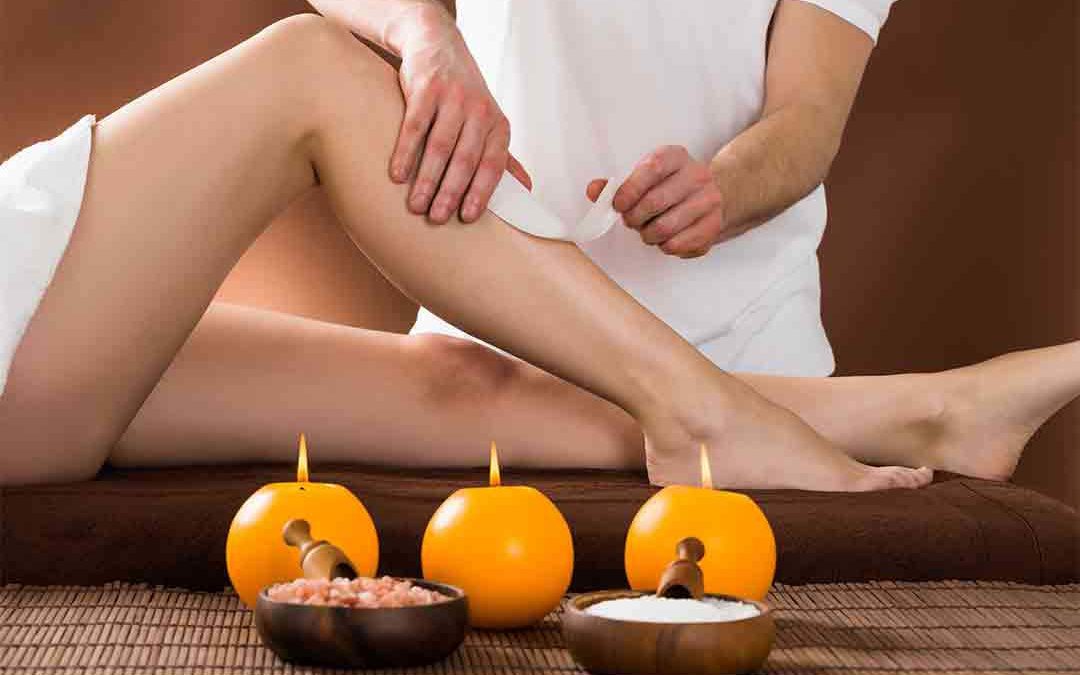
There is a long-standing debate about which direction to apply and which direction to remove soft and hard waxes from the skin.
Soft Wax
Soft wax is gluey and acts as duct tape. It adheres to the hairs, and also to the skin when it is exposed during waxing. By pulling the wax strip off the skin, it pulls hairs off of the skin as well as a very superficial layer of the skin.
Most estheticians apply soft wax only once on the skin and don’t reapply it even if some hairs still remain. This is because, by reapplying the wax, there is a possibility of removing more layers of the skin and damaging it. In the esthetician’s language, removing a thicker layer of the skin is called “lifting the skin” and is a nightmare both for the esthetician and the client. It is painful, takes time to heal, and may leave behind hyperpigmentation and other complications.

Soft wax sticks to the hair, and, thus, only a very thin layer of it is enough to adhere to the hairs on one side and to the waxing strip (muslin) on the other side. Soft wax is like double-sided tape.

A poor waxing technique
Hard Wax
Hard wax is formed by integrated resin molecules that, after being applied to the skin, shrink and mold around the hair shaft and grasp it. Hard wax must be a little thicker, and sometimes a little warmer, to easily go around the hair and grasp it.

Most hard waxes are not gluey and thus don’t stick to the skin and rarely remove any skin tissues. That is why most estheticians don’t hesitate to reapply hard wax more than once on the same area of the skin.
Snapping Hair
Both soft and hard wax grab the hair as close as possible to its root to reduce the chance of hair removal complications and left-over hair on the skin.
Hair is stretchable, and if the wax does not pull it from its root next to the skin, the hair stretches and may snap somewhere in between the hair root and the portion of hair that is attached to the wax or inside the hair follicle. Waxing, if not done right, stretches the hairs and may break them.
Pulling the hair while it is still connected to the hair follicle is painful. That is why all estheticians highly encourage clients to cut their hairs to a specified length before making any waxing appointment.

Stretching and snapping hairs inside or outside of the hair follicle not only is painful but also increases the chance of ingrown hairs, folliculitis, and other waxing and even sugaring hair removal complications. Some of the infamous hairs that pop up a couple of days after waxing are those broken hairs inside the hair follicles that have been removed from their roots completely.

Hair Removal Direction
Soft wax needs to adhere as close as possible to the root of the hair and also stick to a good portion of hair length so it has enough handle to defeat the resistance of the hair follicle and pull the hair out of the skin.

By applying soft wax in the same direction as the hair growth, the hair lies on the surface of the skin and the wax can readily stick to its longest length and also its root on the surface of the skin. Applying soft wax in the same direction of hair growth is the perfect situation for the wax to grab and remove hairs.
Hard wax, on the other hand, is better to be applied in the opposite direction of the hair growth. By applying it in the opposite direction of hair growth, part of the hair lifts from the surface of the skin and gives some room for the wax to run behind the hair and grasps the whole girth of the hair. Also, when you apply the hard wax in the opposite direction of the hair growth, the wax has plenty of room to enter into the base of the hair and grab it from its base to the skin surface.

Removing Hard and Soft Wax
Removing the hair in the same direction as hair growth is desirable for both soft and hard wax. Almost all hair follicles have a sharp angle with the skin. If you remove the hair vigorously in the opposite direction of hair growth, there is a chance that you cut the edge of the hair follicle openings. This cut not only is very painful but also it is a wound and takes time to heal. In addition to that, in the process of healing, the hair follicle opening becomes narrower or even totally closed. The day after a soft wax treatment, it will become clear that the opening of the hair follicle has been traumatized and, in the process of healing, closed or narrowed.


Soft wax, if removed in the opposite direction of hair growth, has already had enough of the hair attached to it that the hair stays connected to the wax and comes off completely from the hair follicle. Removing soft wax in the same direction of hair growth increases the chance of detaching the wax from the hair at the base on the surface of the skin. This can end up separating the whole hair from the soft wax and leaving the hair behind, unremoved, or stretched, increasing the chance of ingrown hair and other hair removal complications.
Hard wax, on the other hand, grasps the hair like tweezers, and it doesn’t matter which direction you pull the hair off of the skin—the hair is stuck to the wax. Removing the wax in the same direction as hair growth, however, reduces the friction of the hair follicle and also reduces the chance of cutting the edge of the hair follicle opening.


Conclusion
Applying hard wax in the opposite direction of hair growth and removing it in the same direction of the hair is less painful, with less possibility of ingrown hair and other hair removal dilemmas. Applying soft wax in the same direction of hair growth increases the chance of adhering a much longer portion of the hair to the wax, and, consequently, there is less chance of stretching the hair and breaking it.